Coach the team, not just the people in it. This program teaches team coaching as a discipline distinct from team building, training, consulting, mentoring, and facilitation — in alignment with the ICF Team Coaching Core Competencies, with the team as the client and a systems approach throughout. 68 hours, ICF AATC-accredited, and the pathway to your ACTC.
A team is not a group of individuals. It is a living system with a life of its own.
Available exclusively to members of the HWH® Coach Club.
ICF AATC
npn InstituteCoach eight people one at a time and you get eight better individuals inside the same broken system. The pattern lives between them — in the agreements nobody made out loud, the conflicts nobody names, the norms nobody chose. That is the client. Most coaches were never trained to work there.
A team's dysfunction is not the sum of its members' deficits. It is emergent — produced by the relationships, not the parts. You cannot coach it out one person at a time, because the system reproduces the pattern faster than any individual can change it.
Team and organizational work is a rapidly growing, high-value niche — and the ACTC is the credential enterprise buyers look for. It is the difference between selling hours and selling transformation to an organization.
This is not running a workshop. It is a repeatable engagement arc — contract, diagnose, measure, propose, develop, evaluate — held inside the ICF Team Coaching Competencies and evidenced by validated assessment.
You cannot coach a team out of a pattern the system is committed to keeping. You can help the system see itself — and that is a learnable skill.
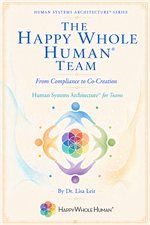
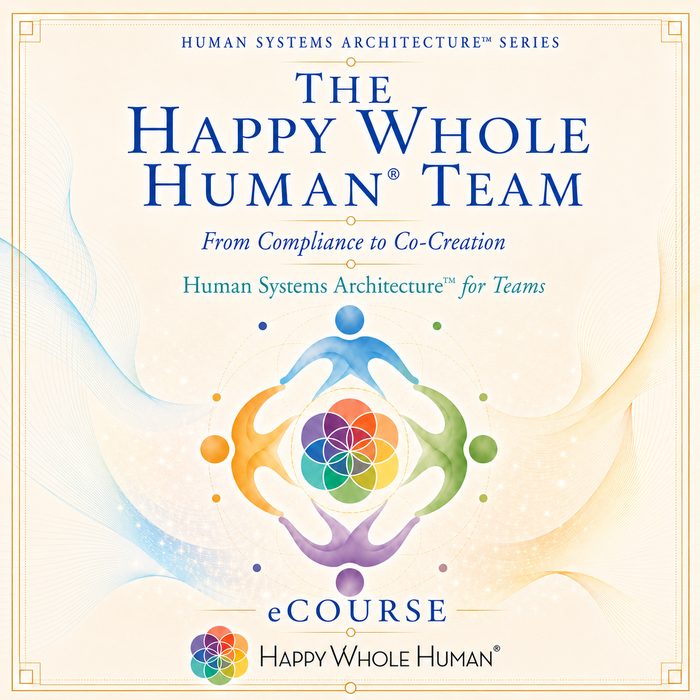
Every team lives somewhere on a continuum. This is the one thing we are teaching you to move a team along — and it is the subtitle of the book this track is built on: The Happy Whole Human® Team — From Compliance to Co-Creation Through Role Integrity, Mutuality, and Conscious Team Coevolution, Book 3 of the Human Systems Architecture™ Series.
Members do what they are told because they are told. Compliance keeps a team functional — and it can look like alignment from a distance. People nod. They complete tasks. They use the language. But compliance is not commitment.
Members agree in form because disagreement is too costly to surface. Consensus keeps a team polite — and quietly expensive. The dissent does not disappear; it just goes underground.
Members work alongside one another on a shared task, dividing labor competently. Collaboration keeps a team productive. Most “good” teams stop here — and most team development never aims past it.
Many sovereign intelligences meeting in one living field and producing, between them, something none of them could have produced alone. Co-creation is what makes a team alive.
“The HWH® goal for teams is co-creation — the place where the team becomes more than the sum of its members, and the work begins to carry the signature of the field itself rather than the signature of any one author.”
Co-creation is not endless consensus, and not every decision being democratic. It means people are genuinely invited to shape how the team works, influence decisions where appropriate, and contribute ideas that can change what happens. Getting a team there calls for cultivating, in each member, the capacity for functional, results-oriented interdependence — neither the over-functioning of forced dependence, nor the under-functioning of defensive independence, but the mature interdependence in which each member's wholeness is the very thing that lets the team produce.
This is why the ecosystem matters. The books, the eCourses, the Team Pulse™ and its nine domains, the protocols, and the AI companions all exist to move a team along this continuum — and to show you, in data, how far it moved. See the whole HWH® ecosystem →

Human Systems Architecture™ treats a team as a complex adaptive system — a living body with its own history, defenses, and intelligence. This is the Team & Organizational track of the HSA™ Series: the same architecture that maps the inner system of an individual, scaled to the system between people.
You will learn to facilitate team coherence — resolving the tensions between members so that coherence translates into clarity, alignment, and measurable improvement in how a team thinks, decides, and performs, as captured by the Team Pulse™ and the Holistogram™ Aggregate, and in how they show up for each other and the organization.
A team is not a linear problem-solving unit. Every action, inaction, or spoken word influences the whole. You stop looking for the broken part, because there isn't one.
You cannot stand outside what you are coaching. Your presence changes the system — so you observe, reflect, and participate with integrity rather than pretending to be a neutral instrument.
Rather than fixing or forcing, you foster the conditions in which meaningful, self-sustaining shifts arise. You are a gardener, not a mechanic.
Each member can choose how to show up, regardless of how the others are behaving. That is the doorway out of blame — and it belongs to every person in the system.
Team coaching is designed to build self-sustaining capability — the capacity to grow, reflect, and self-correct without you. You enhance ongoing performance, empower the team to co-create its own solutions, support a mature and cohesive identity, align around shared purpose and values, and cultivate the capacity to collaborate in complex, fast-evolving environments.
The measure of your success is not how much they need you. It is how well they run when you are gone.
Grounded in Family Systems Theory, Attachment Theory, the HWH Mutuality Model, the Agile Wellness Framework, Ecopsychology, and applied neuroscience — integrated into a single architecture rather than assembled from borrowed parts.
And integrated with ICF-aligned coaching, so all of it fits inside a real organizational engagement, ethically and within scope.
The team is the client. The coach is in the system. Presence is the instrument. Integrity is the ground.
Before you can coach a team, you need to know whether you have one — and whether what you're doing is coaching. The ICF is precise about both, and this program is built to that standard.
That is the whole definition. Shared interest, shared training, shared manager — but no shared fate. Group coaching partners with individuals who share a common interest or learning experience, where the coach and other members offer support to maximize individual potential.
Three conditions: common purpose, shared goals, and interdependence in a shared context. Miss any one and you have a group. That distinction decides your contract, your method, and your credential.
…in a way that inspires them to maximize their abilities and potential in order to reach their common purpose and shared goals. And the sentence the ICF adds next matters most: team coaching is not leader behavior.
In the ICF Core Competencies, “client” usually means an individual. Applied alongside the Team Coaching Competencies, the client is the team as a single entity — made up of individual members, each of whom must be heard and play an integral role. The coach stays objective and is never perceived as taking sides.
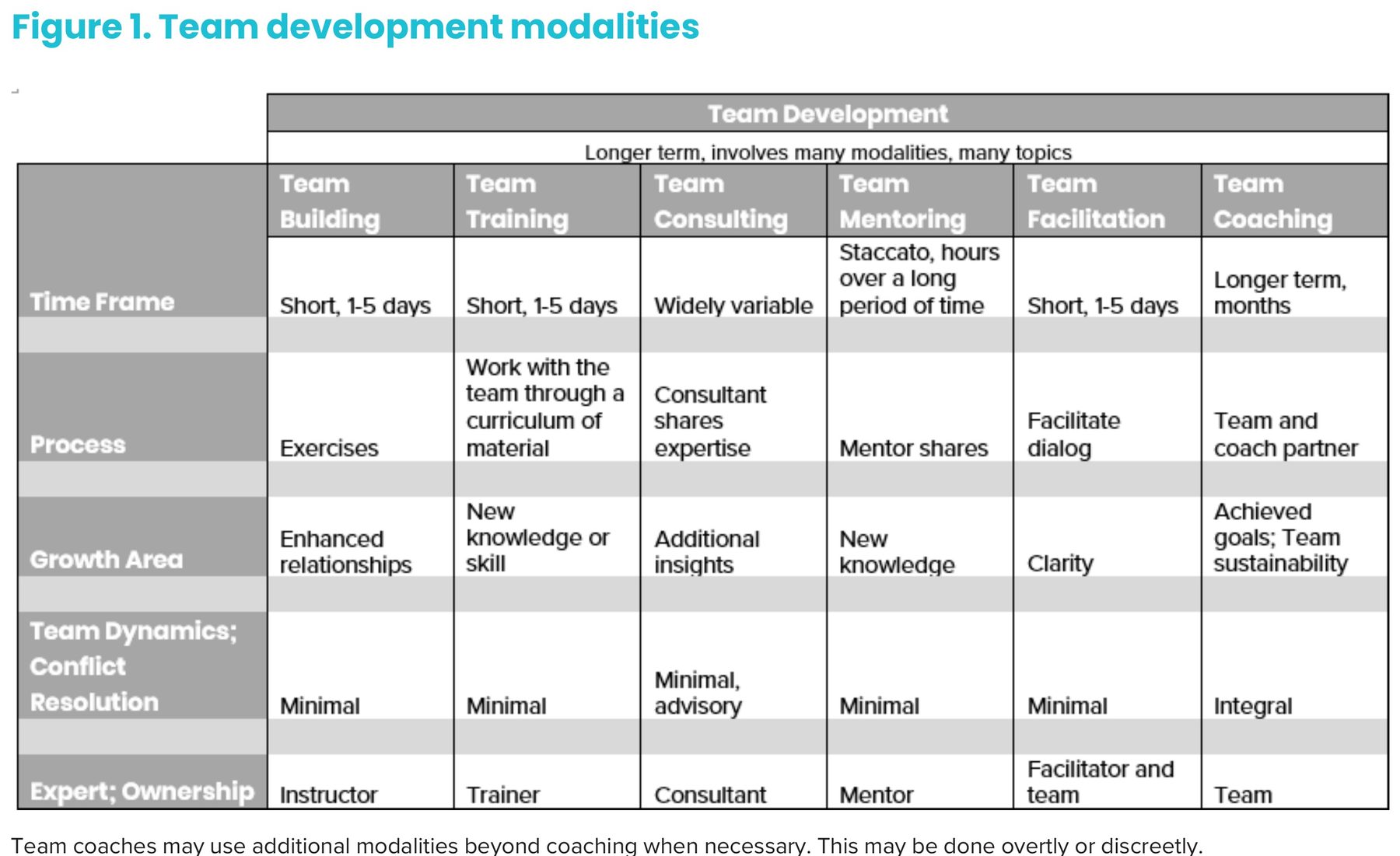
Team coaching sits under the umbrella of team development alongside team building, training, consulting, mentoring, and facilitation. Knowing exactly where you are on this chart — and being able to say so to a sponsor — is the difference between an ethical engagement and a confused one.
Read the chart down the last column. Team coaching is the only modality where the time frame is longer term, months; where the process is team and coach partnering rather than an expert sharing; where the growth area is achieved goals and team sustainability; where conflict resolution is integral rather than minimal; and where ownership sits with the team, not the instructor, trainer, consultant, mentor, or facilitator. The ICF cautions that training, consulting, and mentoring are directive and therefore distinct from coaching — while acknowledging there is a continuum between facilitation and coaching that a good team coach moves along seamlessly. Classes 02 and 03 teach you to work that continuum deliberately, and to recontract when you step off it.
A team is not a unit on an org chart or a collection of people who share a manager. It is a living human system — adaptive, relational, ecological — with its own nervous system, its own meaning-making, and its own intelligence about safety and threat. Multiple living systems meet and produce a third entity: the field between members, the us that becomes a coherent thing over time. You will learn to sense it, name it, and work it.
A difficulty inside a five-quarter strategic horizon feels enormous. The same difficulty inside the timescale of a living planet looks different — not smaller in importance, but in proportion. The team holds it with less reactivity.
The human nervous system, returned even briefly to contact with the natural world, settles. Members come back after a walk outdoors with more access to their Adult Self in Charge™ than they had ten minutes before. You learn to build that into the work.
Natural systems have been functioning with their own intelligence for billions of years. Widening the frame past the organization, past the industry, gives a team access to wisdom its own politics cannot reach.
A team that cannot name its dynamic in psychological language can often name it ecologically. “We are a forest after a fire — there is loss here, and there is also new growth the fire made possible.” The metaphor opens a conversation literal language could not.
Natural systems teach interdependence without sentimentality. They teach limits, cycles, succession, decomposition, renewal, dormancy, and consequence. They do not confuse speed with health, extraction with productivity, or decay with failure — and they do not pretend a system can thrive while destroying the conditions that sustain it. A team that remembers its ecological nature becomes less likely to confuse exhaustion with excellence, dominance with leadership, urgency with importance, and control with care.
The nervous-system layer is taught, not gestured at. Class 14 works the energetic field directly — the felt emotional, somatic, and relational climate that emerges when people gather. Grounded in Polyvagal Theory (Porges) and the science of co-regulation: nervous systems listen to each other, whether or not anyone says so. You will practice sensing and tracking subtle field dynamics, naming them, applying field-based interventions, and maintaining your own energetic hygiene and self-regulation as the coach — because you are in the system you are coaching, and your state is part of its climate.
The stages run in order for a reason — each one earns the right to the next. You contract before you diagnose, you measure before you propose, and you never develop a team you have not yet understood. Skip a stage and the engagement stalls.
Partner with the sponsor, the leader, and the team. Surface mixed expectations before they become misalignment, assess readiness, and co-create values-aligned agreements. Classes 05–06.
Phase I stakeholder interviews that surface patterns rather than opinions — listening for power, safety, conflict, and interdependence, and for what nobody is saying. Classes 07.
Teams Pulse™, the Holistogram™ Aggregate, and the DPI for Teams give the system a mirror it cannot argue with — administered and debriefed on the HWH platform. Class 08.
Synthesize findings into a summary report and a proposal that defines scope, deliverables, and fees — then the Phase II agreement it attaches to. Class 09.
The introductory session, values and intentional agreements, the midstream session, and Team Detox & Negotiation when conflict surfaces. Classes 10–13.
Reassessment and delta reporting with the team and the sponsor, follow-up, and the design of the next cycle. Class 14.
The arc is what separates a team coach from a facilitator with a deck. It is also what makes the work sellable: a sponsor can see exactly what they are buying, and exactly what changed.
Eleven objectives, mapped to the ICF Team Coaching Core Competencies and assessed across the fourteen live classes, your supervision hours, and your observed team sessions. On completion, participants will be able to:
Confidently and competently navigate the unique complexities of working with teams as dynamic, living systems.
Distinguish team coaching from other team development modalities and navigate these with clarity and ethical alignment.
Understand and work effectively with the relational and systemic dynamics unique to teams, including power differentials, psychological safety, conflict, and interdependence.
Partner with sponsors, team leaders, and team members to co-create clear, values-aligned coaching agreements and shared expectations.
Design and facilitate strengths-based team development processes that foster cohesion, psychological safety, and shared ownership of results.
Support teams in identifying shared purpose, clarifying roles and responsibilities, and creating norms that support high performance and team health.
Coach teams to surface and resolve conflict constructively, promote inclusive dialogue, and navigate change with agility and resilience.
Encourage and support team autonomy, learning, and long-term sustainability by helping teams become more self-reflective, adaptive, and empowered.
Apply a systemic lens to team coaching, ensuring alignment with broader organizational stakeholders and mission.
Understand the ethical considerations and boundaries when integrating modalities (individual coaching, team coaching, facilitation), and know when to recontract.
Recognize when to seek supervision or pause coaching to ensure psychological safety and process integrity.
Fourteen 2-hour live Zoom classes (28 hrs) plus 6 hours of group supervision make up your 34 synchronous hours — ICF requires at least 50% of an AATC program be live. A further 34 asynchronous hours of eCourses, reading, and assignments complete the 68.
Family Systems Theory & the Mutuality Model
The client is the team, not the individuals
Complexity, emergence, agency
Agility as the team's operating system
Sponsor, leader, team — the three-party reality
Readiness, red flags, preparing the soil
Listening into the system; absence as data
Teams Pulse™, Holistogram™ Aggregate, DPI
Synthesis and the scope-defining document
Session architecture and facilitation
First contact with the team as client
Shared purpose, norms, the GPS for Teams
Reflect, Reframe, Request
The energetic field, evaluation, your credential
With one client, the ethical questions are relatively contained. With a team you have a sponsor who pays, a leader with power, members with careers, and an organization with an agenda — and all of them think they are the client. The ICF is explicit that supervision is more important for team coaches due to the complexity of the work and the ease with which a team coach can get mired in internal team dynamics. This program is built around that sentence.
The team as a single entity — not the sponsor who signed, not the leader who invited you, not the member who confides in you at the break. Each member must be heard and play an integral role, and the coach is never perceived as taking sides.
Neutrality is a fiction in a room with power in it — and a coach who claims it usually just sides with whoever is loudest. Multipartiality is the discipline of being allied with every member at once: you hold each person's truth as legitimate, in turn, while remaining loyal to the team as the client. It is drawn from the mediation tradition Dr. Leit trained in at UT Law, and it is a practiced skill, not a posture.
What the sponsor is owed, what the team is owed, and what an individual said in a diagnostic interview are three different things. You learn to report in aggregate — informing the sponsor without exposing anyone — and to contract that boundary explicitly, up front, in writing.
Training, consulting, and mentoring are directive and distinct from coaching. Facilitation and coaching sit on a continuum. You learn to know where you are, to move deliberately rather than drift, and to recontract openly when the engagement needs something other than coaching.
The ICF says it plainly: team coaching does not include taking on team leader behaviors. The pull to rescue a struggling team by leading it is constant. Naming that pull — and resisting it — is a trained skill.
A team member cannot freely decline coaching their VP scheduled. Power differentials shape what gets said and what stays unsaid. You learn to work with that reality honestly rather than pretend the room is flat.
Some things are not coaching problems. Active harassment, clinical distress, a decision already made above the team's heads. You learn to recognize the line, to protect psychological safety over the engagement, and to say so — even when it costs you the contract.
Team coaching does not diagnose or treat, does not replace mental-health care, and is not organizational consulting. It partners with the team as the client, within an ICF-aligned scope. This program is explicit about every one of those lines.
The HWH® Institute shares the values of A Galveston Declaration — a statement of values from the collaborative and systemic practice community, born out of a 2016 think tank on Galveston Island, Texas. It names, in four contrasting pairs, the stance this training is built on.
Why this belongs on a team coaching page. Every line of that table has a direct consequence in a team session. Pluralism is why the Team Pulse™ is a snapshot and not a verdict, and why six members can hold six truths at once. Flux is why we practice multipartiality rather than claiming a neutrality that does not exist — the declaration explicitly prefers “every interaction as mutual influence” over “assuming neutrality and objectivity,” which is the same reason we teach that the coach is part of the system. Opening space is why you invite rather than impose. And responsibility — noticing resources rather than diagnosing deficits, and “developing sustainable ecologies” — is the ecopsychological thread running through the whole program. Read the full declaration and its signatories →
The ICF names supervision as more important for team coaches — because the work is complex and a coach can get mired in a team's internal dynamics without noticing. So we don't ration it. Supervision runs every week, as a drop-in, for as long as you are in the program and beyond it as a Coach Club member. You are never sitting on a hard engagement waiting for a cohort to reconvene.
No booking, no cohort, no waiting. Drop in as needed for group supervision with an eligible Coaching Supervisor or ICF Mentor Coach, focused on your live team coaching practice. Come every week or come the week an engagement gets hard. Six hours are included; a minimum of five is required to complete the program and satisfy the ICF supervision requirement — and the sessions keep running whether or not you have hit your five.
This is where the complexity gets worked: the sponsor who wants a side conversation, the leader dominating the room, the member who went quiet in week three, the moment you realized mid-session you had drifted into consulting. Bring the engagement you are actually in, to a supervisor who has coached teams inside global enterprises and supervised 150+ coaches through their own.
Alongside the 68, you complete 20 hours of team engagements including 2 observed sessions with written feedback, submitted via the HWH ICF Team Coaching Observation Form. These are ICF experience hours and sit outside the training hours. We help you source them — peer team coaching labs, pilot groups you form yourself, pro bono engagements with startups and nonprofits, and referrals through the HWH marketplace.
You are joining a community of practice that co-creates rather than competes — the HWH Coaches WhatsApp forum for the question you need answered today, peer coaching trades, and a global cohort of coaches working the same competencies across individual, executive, couples, and team contexts.
And it is a referral network, not just a support group. Team engagements are big, and few coaches should run one alone: members co-coach, hand off, and bring each other into work that fits. Your practice is listed in the HWH marketplace, taking inbound referrals from an ecosystem actively selling into consumer and enterprise markets.
Sessions pause for holiday periods and scheduled institute breaks; the current calendar is published in the HWH App and shared at enrollment. Supervision is open across the HWH programs, so you are supervised alongside executive, couples, and hypnotic coaches working the same competencies. See the mentoring & supervision schedule →
You will learn to facilitate the HWH assessments and Human Systems Architecture™ for Teams yourself — administering, interpreting, and debriefing each validated instrument on the HWH interactive platform, with aggregate report and workshop templates included. Every engagement opens with a baseline and closes with a reassessment, so the team — and the sponsor who paid for it — can see exactly what moved.

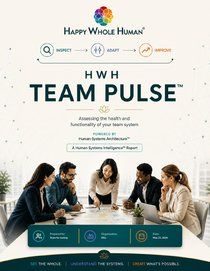
The nine domains of Human Systems Architecture™ for Teams: Readiness, Context, Culture, Connection, Alignment, Momentum, Performance, Systems, Agility. Members' responses aggregate into one team-system health report — trust and dynamics, initial and retake. A snapshot, not a verdict.

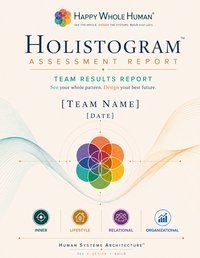
The validated, award-winning 28-dimension whole-person map across Inner, Lifestyle, Relational, and Organizational domains. Each member generates a personal report; the team rolls up into an aggregate. Normed against 740+ participants.

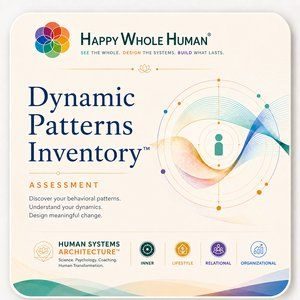
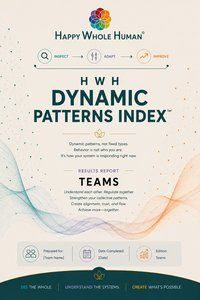
110 items, 10 dimensions, the Maturity Map™, initial and retake. One assessment that scales across levels — individual, couples, and team aggregate — revealing how the system behaves under pressure and where collective blind spots sit.
Every instrument on the team track produces a report you can put in front of a sponsor — aggregate, delta-tracked, and privacy-first.

Members' responses aggregate into one team-system health report across the nine domains, with a leader summary of blind spots and high-leverage action areas, and a time-series dashboard tracking health across retakes.

The aggregate roll-up: each member's individual report stays theirs, while the team sees itself as a whole across all 28 dimensions — the wellbeing conditions underneath the performance.

The team aggregate of collective dynamics and blind spots — how this particular system behaves when it is under pressure, and which patterns are driving the results the other instruments are measuring.
Each instrument carries its own ICF-accredited facilitator eCourse. You do not license a tool you were never taught to debrief.

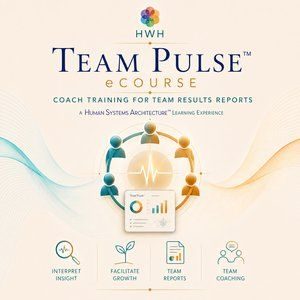
Coach training for Team Results Reports. ICF AATC-accredited — the facilitator training that pairs directly with this program.

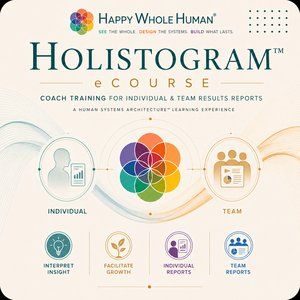
Facilitator training for the individual and aggregate Holistogram™ reports — how to debrief 28 dimensions without diagnosing a single person.

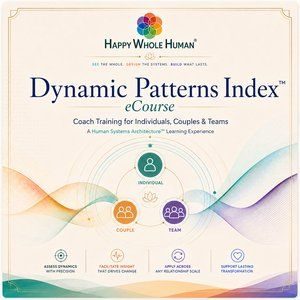
Facilitator training for the DPI™ across individual, couples, and team levels — including the Maturity Map™ and the team aggregate debrief.
You will learn where team coaching sits and where it does not — the boundaries between coaching, facilitation, consulting, and training; the multi-stakeholder confidentiality problem; aggregate reporting that informs a sponsor without exposing an individual; and when to recontract or pause to protect psychological safety. Team coaching does not include taking on team leader behaviors, and this program is explicit about the line.
You are not leaving with a certificate and a reading list. You are leaving with a toolbox brimming with robust, evidence-based tools and methods — named, sequenced, ready-to-run protocols you can open on Monday morning, plus the training to facilitate the HWH assessments and Human Systems Architecture™ for Teams yourself. This is what lets you run transformational, ICF-aligned team coaching initiatives that produce meaningful, measurable, and lasting results.
Every one documented, sourced, and licensed to you as an active Coach Club member.
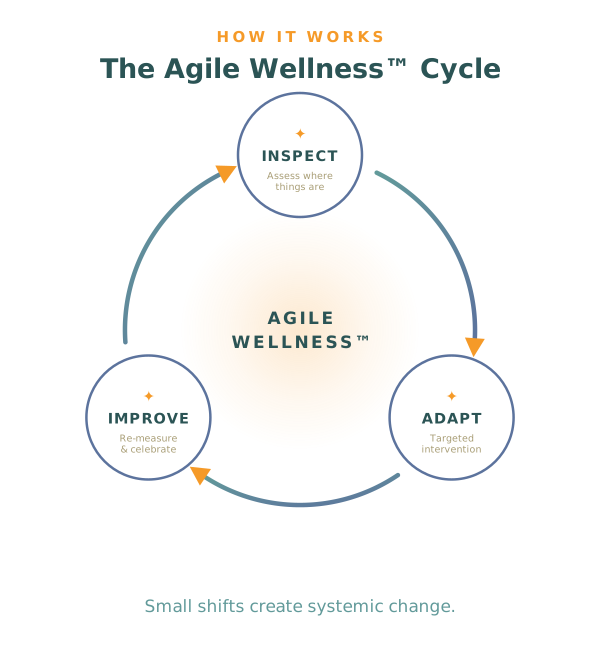
So they can meet what comes — reorg, AI transformation, a quarter that goes sideways — with more skill and more capacity than they had before. Every engagement you deliver runs on the Agile Wellness™ Cycle: measure where the team actually is, intervene with structure and support, then re-measure to reveal and celebrate what moved. Delta measurement is not an add-on at the end. It is built into the process.
The Team Pulse™, Holistogram™ Aggregate, and DPI™ for Teams replace six competing stories with one shared picture across the nine domains. Not a verdict — a baseline. You cannot target what you have not located, and a team cannot argue with a mirror that belongs to none of them individually.
The findings map to a specific entry point — a domain, a protocol, a conversation the team has been avoiding — so you are not guessing and they are not doing generic team building. Structured protocols from the toolbox, held by a trained coach, supported between sessions by the workbook, the eCourse, and the AI companions in the app.
Retake the instrument. Show the delta on the dashboard. Sponsors renew when they can see the change they paid for, and teams keep going when they have evidence they are capable of it. Celebration is not sentiment here — it is reinforcement, and it is what makes change hold.
Small shifts create systemic change. Then you inspect again — and use the new baseline as the starting point for the next phase of the team's development.
This is what separates measured team coaching from hopeful team coaching. Most team coaches never find out whether their work actually helped. You will have the evidence to show for your efforts — and so will your teams, and so will the sponsor who signed the contract.
Most team coaches finish an engagement with a warm feeling and a thank-you email. You will finish with data. Every engagement opens with a validated baseline and closes with a reassessment, and the delta between them is the deliverable — rendered in dashboards and results reports you can share with stakeholders to demonstrate both return on investment and value on investment.
Movement in the domains that carry cost: Performance (execution quality, follow-through), Systems (process maturity, feedback loops), and Readiness (mandate clarity, resource adequacy). Independent validation of the HWH program found a statistically significant increase in employees' intention to stay — retention is a line item, and turnover is expensive.
Movement in Culture (psychological safety, belonging), Connection (information flow, conflict navigation, repair), Momentum (buy-in, collective vitality), and Agility (adaptability under pressure). These are the leading indicators — the conditions that produce the results the ROI columns eventually record.
Baseline at contracting, reassessment at close, time-series dashboards tracking team health across retakes. Aggregate reporting shows the sponsor what moved without exposing any individual — privacy-first, consistent with ICF confidentiality standards. A team can hide from a conversation more easily than it can hide from a pattern.
Everyone in this market says they change teams. You will be able to show, dimension by dimension, exactly what changed — which is why engagements renew, why referrals happen, and why you can price on evidence rather than hours.
Drawn from the Human Systems Architecture™ Series by Dr. Lisa Leit — the practitioner text you train from, and the client-facing texts your teams read. Digital editions are included with enrollment and delivered in the HWH App.

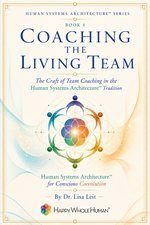
The practitioner text: the engagement arc, the diagnostic interview, the facilitation detail, and the difficult dynamics behind systemic team coaching in HSA™.
The asynchronous spine of your 34 self-paced hours — module by module, mapped to the class it supports.

The book your team clients read to understand themselves as a living system rather than a personality clash.

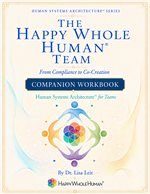
The exercises: values, the GPS for Teams, the MOU worksheet, and the Reflect / Reframe / Request protocol in the team's own hands.
What keeps the team moving between your sessions — delivered in the app under your brand.
Team coaching taught by someone who holds the credential you are pursuing, designed this AATC-accredited curriculum, and teaches every live class herself.

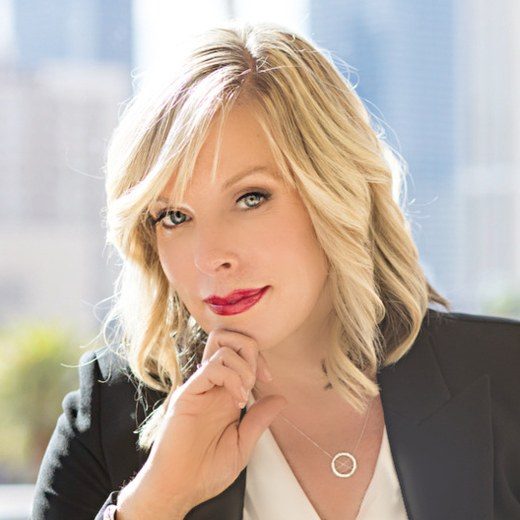
Dr. Leit holds the ICF Advanced Certification in Team Coaching (ACTC) — the credential this program prepares you to apply for — and is an ICF Master Certified Coach (MCC). She designed this AATC-accredited curriculum and teaches every live class herself.
She works as a co-development hub coach, group coach, facilitator, trainer, and team coach with senior leadership populations across global enterprises — often while they are undergoing Agile and AI transformations. She is a Master Executive Coach and an EMCC ESIA-accredited supervisor, an Advanced Family Mediator and Mediator trained at the University of Texas at Austin School of Law, a Master Neuroplastician™, and the creator of Human Systems Architecture™. Ph.D. in Human Ecology, UT Austin.
Full bio, credentials, and client list at www.drlisaleit.com · LinkedIn.
ICF MCC
ICF ACTC
EMCC ESIA
M.npn
AssociationDr. Leit works with senior leaders and teams across global enterprises, healthcare systems, academic institutions, media organizations, and mission-driven companies — and the HWH® program itself has been independently validated for outcomes. Engagement scope varies by client, and much of the work is held under confidentiality.
“I’m really and truly obsessed with my coach, Dr. Lisa Leit (MCC), who sets an incredibly high bar. The way she combines presence, complete command of ICF competencies, and practical tools from her holistic approach keeps me learning and growing in a meaningful direction.”
“It turns out you can take care of yourself and give more to an organization. You can be whole. It doesn’t have to be this vampire exercise. That, to me, is the major allure of this work, because there is no help unless you identify and stop your co-dependence. That’s why this work is so revolutionary.”
“I can’t say enough nice things about how impressed I am with Dr. Lisa Leit. She is an amazingly gifted educator and coach, and I have benefited tremendously from her guidance, both personally and professionally. I have also referred Lisa and her team to those seeking executive coaching and organizational leadership — and her results are just outstanding.”
“Thanks so much Dr. Lisa Leit and Angela Hollingsworth Gohokar — it was amazing to get your guidance and great inputs. Loved it!! Awesome session and very engaging.”
“The highlight of the [Conscious Capitalism] concurrent sessions was the illuminating Dr. Lisa Leit, Founder of the Happy Whole Human Institute for Holistic Wellness — with client partner Jessica Agneessens of the Academy for Conscious Leadership at Whole Foods Market co-presenting on the customization of the HWH™ Program for Whole Foods.”

Over 18 months, Dr. Leit beta-tested the Holistogram™ and the HWH® program with hundreds of Whole Foods Market leaders — a paid in-store engagement plus leaders from every region.Read All Reviews
Happy Whole Human® earned Validation for Outcomes from the Validation Institute (2022, Well-Being category). An independent review of a 30-participant cohort found a statistically significant increase in employees' intention to stay with their employer. Backed by the Validation Institute's Credibility Guarantee, and recognized with the HealthValue Award — Well-being.



The team track is one part of the Human Systems Architecture™ Series — a connected ecosystem where every book, client eCourse, validated assessment, AI companion, and ICF-accredited training speaks the same language. One architecture, four contexts: the individual, the couple, the team, and the organization. It is why an HWH coach can follow a client system anywhere it goes.
Everything on the team track, in one place: the Coaching the Living Team practitioner text and its Team Coach Training eCourse · The Happy Whole Human® Team and its Companion Workbook and client eCourse for your teams · the Team Pulse™, Holistogram™ aggregate, and Dynamic Patterns Index™ team assessments · a Team Results Report and an ICF-accredited facilitator eCourse for each · the Team Readiness Pulse™ for pre-engagement baselining · 35 team-scale protocols and tools · Zola™, the AI companion for team contexts · the cobranded team dashboard · and this 68-hour AATC-accredited training.
This program teaches that the coach is part of the system — that your nervous system is part of the team's climate, and that energetic hygiene is a professional skill rather than a nice idea. It would be incoherent to teach that and then hand you a certificate and wish you luck. So every HWH® Coach Club member gets the whole ecosystem for themselves, not just for their clients.
Take the Holistogram™ yourself and get your own 28-dimension baseline. Run the DPI™ on your own patterns. Retake them and watch your own delta. You will ask clients to be measured — you should know exactly what that feels like from the other side of the report.
The client eCourses, the workbooks, the HSA™ Series books, and the protocol library are yours to use, not just to deliver. Most coaches quietly work the material on themselves first. That is not a loophole — it is the intended order.
The same dashboard your teams get, tracking your own wellbeing over time. Coaching is emotionally load-bearing work and drift is hard to notice from the inside. A time-series makes it visible before it becomes burnout.
Clara™ copilots your practice; Mojo™, Sofie™, Fergus™, and Zola™ support your clients — and you. GDPR-compliant and privacy-first, so the reflective scaffolding you offer others is available to you at 11pm when you are processing a hard session.
Weekly drop-in supervision, the coaches' forum, peer coaching trades, and a global cohort working the same competencies. You are held by the same structures you will hold teams with.
A depleted coach produces a depleted field, and teams read it whether or not it is named. Staying resourced is not self-indulgence in this work. It is part of the instrument you bring into the room — and it is the difference between a long career and a short one.
We are not asking you to model a wholeness we do not resource. Every coach in the Club has their own baseline, their own dashboard, their own supervisor, and their own community — because “Happy Whole Human” is not a product name we sell. It is a standard we are meeting, together.
Most certification programs hand you a certificate and wish you luck. Through the HWH® Coach Club you leave with the full operational stack: a licensed methodology, validated instruments with delta reporting, a co-branded client app, revenue infrastructure, and a community that co-creates rather than competes.
Sponsor questionnaires, contracting checklists, diagnostic interview guides, summary report and proposal builders, agreement templates, and workshop decks — the documents you would otherwise spend two years writing.
Most coaches have testimonials, not data. HWH coaches have before-and-after reports showing measurable change — which is why engagements renew, why referrals happen, and why you price on evidence rather than hours.
List your team-coaching practice in the HWH marketplace and take referrals from an ecosystem actively selling into consumer and enterprise markets.
revenue share on client app subscriptions
revenue share in your favor on eCourse sales
GDPR-compliant, privacy-first AI companions. Context-intelligent companions trained on HWH methodology support your teams between sessions — not generic chatbots — and sponsor reporting stays aggregate, without content capture, consistent with ICF's confidentiality standards. The ethical line is taught explicitly: AI is reflective scaffolding, and team coaching partners with the team's own capability. Coaches do not outsource ethical judgment, confidentiality, stakeholder management, or session presence to AI.
The Team Coach Training is available exclusively to HWH Coach Club members — one of the credential tracks your membership unlocks, not a course you buy on its own.
The HWH® All-Access Coach Club gives you lifetime access to ICF Level 1, Level 2, Level 3, this AATC team track, and the optional ACHE hypnotic track. You are not paying per course. You are joining an ecosystem.
Installments available via Klarna, Afterpay, and Intuit Credit Karma.
All fourteen classes, the complete hour accounting, ICF Team Coaching Competency alignment, the asynchronous curriculum, and completion requirements — the complete syllabus, in the HWH design.
We'll email you the syllabus and start your download immediately. No spam — unsubscribe anytime.
Prefer to talk it through? Book a discovery call with Dr. Lisa Leit, MCC →
HWH® Team Coach Training
Course Syllabus · Evergreen Edition
Fourteen 2-hour classes · group supervision · ICF competency alignment · the asynchronous curriculum · PDF
Coaches pursuing the ICF Advanced Certification in Team Coaching (ACTC), and practitioners who want to coach teams and organizations rather than only individuals. You must hold an ACC, PCC, or MCC credential to apply to the ICF for the ACTC. You may enroll before earning your ICF credential; we recommend completing Level 1 as a minimum prerequisite. Active HWH Coach Club membership is required.
Yes. This is a 68-hour program carrying ICF Advanced Accreditation in Team Coaching (AATC), and it fulfils the education requirement for the ACTC credential. The hours break down as 34 synchronous (fourteen 2-hour live classes plus 6 hours of group supervision) and 34 asynchronous (eCourses, reading, and assignments). ICF requires at least 50% synchronous and a minimum of 30 asynchronous hours — this program meets both.
AATC (Advanced Accreditation in Team Coaching) is the ICF's accreditation of this program. ACTC (Advanced Certification in Team Coaching) is the individual credential you apply for from the ICF after completing an AATC-accredited program, holding an ACC/PCC/MCC credential, and meeting ICF's supervision and team coaching experience requirements. Completing this training satisfies the education requirement; the ACTC is conferred by the ICF, not by HWH.
Group supervision runs as a weekly drop-in, Mondays 11:00–12:00 CST, throughout the program. Six hours are included and a minimum of five is required to complete — ICF requires that five of your synchronous hours be individual or group supervision. The Monday drop-ins run 35 weeks a year.
The program includes 20 hours of team engagements, with 2 observed sessions and written feedback submitted via the HWH ICF Team Coaching Observation Form. These are ICF experience hours and sit outside the 68 training hours. We help you source them — through peer team coaching labs, pilot groups you form yourself, pro bono work with startups and nonprofits, and referrals through the HWH marketplace.
It is not sold separately. This training is included with membership in the HWH® All-Access Coach Club: $12,000 one-time, or $5,000 one-time plus $199/month. Installments are available via Klarna, Afterpay, and Intuit Credit Karma.
No. Facilitation runs a process; consulting supplies answers; training teaches skills. Team coaching partners with the team as a single client in a co-creative, reflective process so it becomes its own best coach. The program is explicit about these boundaries, about when to recontract, and about when to pause coaching to protect psychological safety.
Every organization you want as a client has a team that cannot talk to itself. Earn your 68 AATC-accredited hours, build toward your ICF ACTC, and take the licensed methodology, the validated instruments, and the platform of the Institute with you.

The problem was never the people. It was the system they were operating in.
Download the Full Syllabus Join the Coach Club